
Net zero neighbourhoods
Equans is experienced in delivering place-based decarbonisation projects (including net zero neighbourhoods) that address multiple energy vectors and we take a whole-system approach to decarbonising an area. We are leaders in financial and legal innovation continually seeking solutions to enable decarbonisation of place.Net zero neighbourhoods
Equans is experienced in delivering place-based decarbonisation projects (including net zero neighbourhoods) that address multiple energy vectors and we take a whole-system approach to decarbonising an area. We are leaders in financial and legal innovation continually seeking solutions to enable decarbonisation of place.
What is a net zero neighbourhood?
A net zero neighbourhood (NZN) is a place-based approach to decarbonisation that transforms homes, infrastructure, and communities to dramatically reduce carbon emissions while improving quality of life. It integrates low-carbon technologies with smart energy systems, sustainable transport, and green spaces to create a resilient, future-ready local environment.
This can include things like:
- Solar panels on roofs to make electricity
- Batteries to store energy
- Heat pumps to warm homes more efficiently
- Better walking and cycling routes
- Support for electric vehicles
Get in touch
Contact Equans to see how our place-based decarbonisation expertise can help achieve net zero.

But it’s more than just infrastructure. NZNs are designed to tackle fuel poverty, boost local jobs, and empower communities through inclusive governance and investment models. By aligning technical feasibility with social impact, NZNs unlock new pathways for public-private investment and deliver tangible benefits for residents making net zero not just a target, but a lived reality.
A net zero neighbourhood is a local area where homes, buildings, transport, and energy systems are changed to use cleaner, greener energy. The goal is to cut down carbon emissions as much as possible, ideally to zero, while making life better for the people who live there.
It’s also about helping people save money on energy bills, creating local jobs, and making the neighbourhood a healthier, more comfortable place to live.
Our approach
Community centric design is the overarching principle that we deliver by:
- Buildings
- Transport
- Energy infrastructure
- Green / blue space
- Finance is what underpins our programme design

The challenges
These projects can be challenging, and as the trailblazers in this remit, we can recognise, and have dealt with, issues along the way; so are best placed to offer tangible solutions.
Non-technical
Click on the headings to expand the text.
- Public sector funding has not previously been well suited to a place-based approach with different timelines and eligibility criteria making fund stacking particularly challenging
- Private sector funding is not that forthcoming in this area due to the lower rates of return over a prolonged period of time, and since it is a nascent market there is a lack of evidence to demonstrate the guaranteed return on investment
- Local authorities are increasingly underfunded and understaffed, resulting in fewer officers, with increasing amounts of work. This has resulted in innovating approaches to take a more innovative approach which is currently more time consuming to undertake in comparison to standard programmes
- The supply chains are growing, however the due to a lack of certainty with previous grant funding models have not had secure market signals to invest time in re-/training towards net zero / retrofit based works
- The primary recipients of net zero works are social housing tenants, and additional beneficiaries are those that live in and amongst social housing. As a result, communities are often higher on the indices of multiple deprivation ranks, more acutely experiencing fuel poverty and the impacts of the cost of living crisis. This means that their priorities are improved living conditions (e.g., damp, mould, warmer homes, etc.), and lower living costs. To gain community buy-in, alternative language needs to be used that addresses their priorities, whilst also decarbonising in the process
Technical
Click on the headings to expand the text.
- The aging UK housing stock has resulted in the vast majority of properties having an EPC of less than C (the minimum standard set by the government for social housing to reach); which creates uncertainty over the properties performance if a direct electric heating option was made with no other works. The age of the housing stock also means it has undergone several years of “wear and tear” and may be suffering from damp and mould, or require a lot of enabling works to allow the installation of solar PV or other low carbon technologies
- Due to the increased cost of living and increasing levels of fuel poverty, the appetite for many residents to undertake decarbonisation works is minimal, and the ability to self-fund is non-existent. Resultantly, engagement needs to take place to address resident priorities, and funding / financial models developed to enable works to go ahead with minimal self-funding required
- The unit price difference in gas and electricity makes many heat electrification solutions not financially viable on their own (i.e., a direct swap) and additional work is required to ensure heating is affordable e.g., building fabric improvements, additional technology installations.
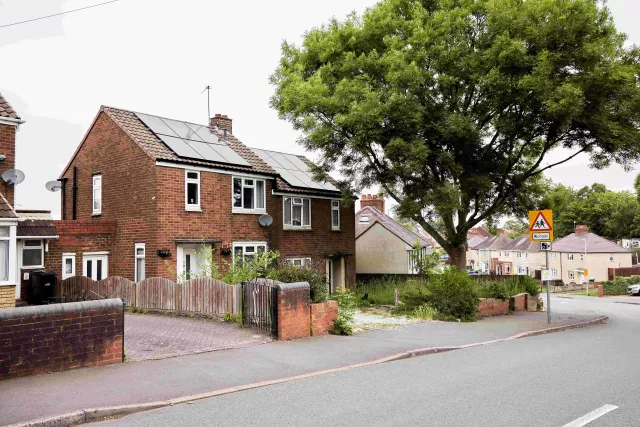
Equans, in partnership with Dudley Metropolitan Borough Council and the West Midlands Combined Authority, is driving the UK’s first net zero neighbourhood in Brockmoor, backed by £1.65 million in funding.
Phase One will retrofit up to 300 homes with advanced insulation, solar panels, battery storage, and low-carbon heating. Working with UrbanChain, a Virtual Power Plant will connect residential and commercial energy, lowering costs, tackling fuel poverty, and providing a scalable model for decarbonisation across the region.
Frequently asked questions
A Net Zero Neighbourhood brings together a range of improvements such as renewable energy generation, smarter local energy systems, low‑carbon heating, better walking and cycling routes, support for electric vehicles and enhancements to local green spaces. These elements work together to create a more sustainable, comfortable and resilient local environment.
These projects tackle a range of technical and social challenges, including aging housing stock, rising living costs, limited funding, the gap between gas and electricity prices, community‑wide capacity issues and the varying appetite for net zero initiatives. Equans’ experience means we understand these barriers and can offer practical, proven solutions.
Funding typically comes from a combination of public investment, private finance and innovative commercial models. Equans is recognised for developing financial and legal mechanisms that unlock projects which may otherwise be difficult to fund. This allows local authorities and partners to deliver neighbourhood‑wide improvements without placing disproportionate financial pressure on residents.
By improving homes and infrastructure, these projects create demand for skilled jobs in construction, engineering, project management and energy services. They also help develop long‑term green skills within the local workforce, supporting regional economic growth while ensuring that local people benefit directly from the transition to net zero.
Our expertise
Equans supports businesses, communities and the public sector by mobilising its expertise to provide low-carbon energy solutions, offer cutting-edge technical and FM services and transformative regeneration across the UK & Ireland.