Insight Insight 2026-02-26
Unlocking funding and innovation for NHS healthcare estates: decarbonisation, digitalisation & climate adaptation
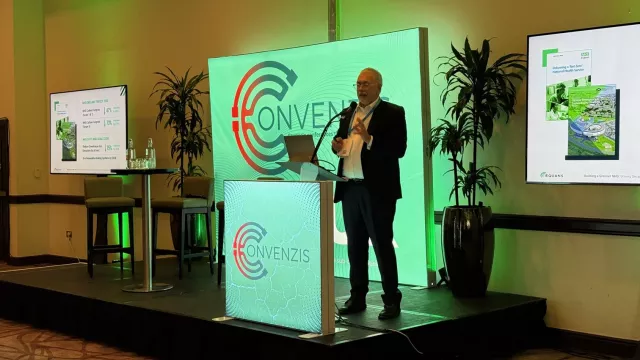
As the NHS places more emphasis on creating greener, smarter, and more resilient estates, the challenge of transforming retained hospital buildings - many of which are aged and complex - has never been greater. Our Regional Director, Simon Hayman recently presented a compelling case study at the Convenzis Health Estates Conference, focusing on how funding opportunities, strategic planning, and innovative solutions can unlock progress in decarbonisation, digitalisation, and climate adaptation across NHS estates.
Decarbonisation and climate adaptation: two sides of the healthcare estate challenge
One critical insight is that decarbonisation and climate adaptation, while interrelated, are distinct challenges. Decarbonisation seeks to reduce greenhouse gas emissions and energy consumption, aiming at ambitious interim targets such as the NHS England goal of a 47% reduction by 2032 (based on 2019 levels). Conversely, climate adaptation focuses on preparing estates to withstand extreme weather events and environmental shifts that threaten patient safety and infrastructure resilience.
For example, NHS Scotland has set an equally ambitious target, aiming for a 75% emissions reduction by 2030, though this baseline is dated back to 1998 and poses unique challenges and urgencies.
Navigating the funding landscape amid capital constraints
Simon highlighted a persistent obstacle: previous capital funding for healthcare estates has shrunk or been withdrawn, creating a bottleneck for essential upgrades. Although numerous grants exist, their practical integration into NHS capital budgets remains difficult because of the restrictions imposed by the Capital Departmental Expenditure Limit (CDEL) regulations. This regulation often disincentivizes trusts from leveraging freely available grants if this would negatively impact their capital expenditure allowances.
Therefore, trusts and partners must be creative and strategic in tapping into funding streams while balancing compliance and fiscal responsibility.
The pathway to decarbonisation: NISTA’s five-stage framework
A pragmatic approach to decarbonisation comes from the NISTA five-stage plan Simon explained, which offers a roadmap:
- Data first: collate and calculate the baseload data for scope 1 and 2 emissions.
- Engage on site: Develop close collaboration with on-site teams to identify real opportunities and constraints.
- Improve Building Management Systems (BMS) and installation quality: Upgrade and optimise control systems for better energy efficiency.
- Produce costed net zero plans: Design actionable roadmaps with transparent costs.
- Leverage ‘off-the-shelf’ applications: Utilise existing NHS grants and programmes that offer practical funding to execute improvements swiftly.
Through this staged approach, trusts can make their decarbonisation ambitions concrete and achievable, starting with what they know and building momentum.
Innovations in energy and infrastructure: case studies and technologies
Simon shared several practical case studies demonstrating how investment and innovation can yield cost and carbon savings:
- Cambridgeshire solar PV integration: A pioneering bi-directional Power Purchase Agreement enabled solar generation to be integrated into a PFI scheme, addressing supply chain volatility and aligning budgets within fixed timescales.
- Energy performance enhancement: Following identified building defects and delayed seasonal commissioning, a hospital trust was able to install stepped-down ventilation systems funded via the NHS Energy Efficiency Fund, achieving both financial savings (£88k/year) and carbon reductions (96 tonnes CO2e).
On the technology front, solutions such as energy storage, heat pumps, and low carbon heat networks present viable pathways to reduce emissions and manage hospital energy loads more effectively. Two live examples of government-funded low carbon heat networks operate in North west London and Hounslow, showcasing scalable models for other trusts.
Effective district heat networks rely on reducing heat loss and optimising BMS controls across temperature ranges, aided by schemes such as the Green Heat Network Fund and Heat Network Efficiency Scheme, which help reduce connection charges and operating expenses.
The Department for Energy Security and Net Zero (DESNZ) provides technical support and regulatory direction, underscoring the inevitability of enforced district heat network connections - all elements of ensuring resilient, climate-adaptive estate infrastructure.
Adapting NHS estates for a changing climate
Climate adaptation is no longer a secondary consideration. The Task Force on Climate-related Financial Disclosures (TCFD) Phase 3 highlights the critical need for healthcare estates, including NHS facilities, to proactively assess and mitigate climate-related risks. This phase emphasizes enhancing the resilience of infrastructure to withstand evolving climate challenges while ensuring the ongoing comfort and safety of patients during increasingly frequent and severe weather events. By adopting these principles, NHS estates can better prepare for the impacts of a changing climate, safeguard operational continuity, and maintain high standards of care in the face of environmental uncertainty.
The NHS Estate Safety Fund supports improvements such as flood protection and cooling upgrades in critical infrastructure.
Equans supports public sector organisations to improve the climate resilience of buildings and critical operations. Testament to that is Leeds Teaching Hospitals NHS Trust, the first to undergo extensive climate damage assessment by our Carbon Shift team, covering building resilience, climate modelling, and bespoke engineering recommendations.
Digitalisation: unlocking smarter, more efficient NHS operations
Digital transformation emerges as a crucial enabler for both decarbonisation and climate resilience. The government’s £10 billion technology investment plan for the NHS through 2028-29 shows increasing commitment. Even within retained estates, relatively modest sums can deliver substantial improvements in digital maturity through targeted assessments and phased funding.
Simon underscored the need for every trust to develop an overarching digital vision or strategy tailored to their retained buildings - what we at Equans call the ‘Smart Hospital’ approach. Examples include:
- Asset tracking such as locating clinical equipment like wheelchairs via sensor networks.
- Space utilisation improvements through occupancy sensors enabling better room usage.
- Condition-based maintenance where remote monitoring of assets facilitates timely statutory preventive maintenance.
These digital interventions will drive improvements in efficiency, patient experience, staff productivity, and ultimately impact NHS league tables financially and operationally. Digital tools help move beyond manual processes like spreadsheets and whiteboards, delivering streamlined patient flow, improved alarm prioritisation, and data-driven decision making.
Seizing the moment: collaboration and skills development
Simon also acknowledged the workforce skills gap in delivering complex decarbonisation and adaptation projects - a challenge noted in recent industry case studies. By leveraging initiatives like the NHS Energy Efficiency Fund and the Scotland Carbon Reduction Programme, Equans has helped bridge this gap through training and deployment of specialist skills.
This collaborative, stepwise approach is essential to transforming what can be an overwhelming agenda into actionable programmes that deliver value and align with NHS priorities.
Conclusion
The imperative to decarbonise and climate-proof NHS healthcare estates is urgent but achievable with clear strategies, smart funding use, and digital enablement. Simon Hayman’s insights from the Health Estates Conference remind us that while the challenges are complex, the coming decade offers unprecedented opportunity to modernise the NHS estate - delivering greener, safer, and more efficient healthcare environments for patients and staff alike.
At Equans, we remain steadfast in supporting NHS trusts through every stage of this journey with technical expertise, innovative solutions, and deep sector understanding. Together, we can empower the transitions that will define modern healthcare estates for generations to come.