
Estate Climate Risk, Adaptation and Resilience Assessment
Equans delivered a bespoke Climate Risk, Adaptation and Resilience Assessment to help LTHT proactively address climate challenges and future-proof critical healthcare infrastructureEstate Climate Risk, Adaptation and Resilience Assessment
Equans delivered a bespoke Climate Risk, Adaptation and Resilience Assessment to help LTHT proactively address climate challenges and future-proof critical healthcare infrastructure
Key facts
Key facts
The challenge
There is a growing awareness of the need to be more resilient to physical climate change risks due to the intensifying frequency and severity of extreme weather events.
Hospitals must contend with climate risks like heat stress, extreme cold, extreme rainfall and flooding - all of which can significantly disrupt operations and compromise patient safety. Leeds Teaching Hospitals needed an expert to assess their physical vulnerabilities and deliver actionable insights for effective climate adaptation.
Overview
We’ve all experienced discomfort in buildings during extreme weather, but for healthcare facilities these challenges are more than inconveniences - they can directly affect patient care, staff wellbeing and critical operations.
Leeds Teaching Hospitals NHS Trust is proactively addressing these challenges head-on and sought expert advice to ensure its buildings remain resilient in the face of climate change.
Equans delivered a market-leading, bespoke Climate Risk, Adaptation and Resilience Assessment to enable the Trust to pre-empt climate-related damage to its estate, identify physical vulnerabilities, plan mitigation strategies and future-proof its facilities against escalating climate risks.
Our work
Climate risk, adaptation, and resilience assessment
Equans prepared a bespoke assessment for Leeds Teaching Hospitals, which reviewed eight buildings across two estates; Leeds General Infirmary and St James’s University Hospital. This assessment incorporated:
Advanced Climate Modelling: Using the Met Office’s UK Climate Projection model (UKCP18) to predict risks under ‘best’ (low levels of climate change), ‘likely’ (material levels of climate change), and ‘worst-case’ (high levels of climate change) scenarios.
Building engineering analysis: Evaluating climate vulnerabilities at building and building component levels to gain a detailed local understanding of climate risk.
Bespoke recommendations: Developing measures to mitigate and adapt buildings to current and future climate risks and aligning them with industry standards, such as CIBSE thermal comfort guidelines to ensure optimal temperatures for building occupants.
As industry organisations increasingly collaborate to understand how places must adapt to new climate realities, Equans’ assessment adopts a focused approach. By analysing risks at the level of individual buildings, this approach creates opportunities for meaningful estates-based interventions, delivering great value by enabling the identification of specific physical risks.
Non-intrusive survey
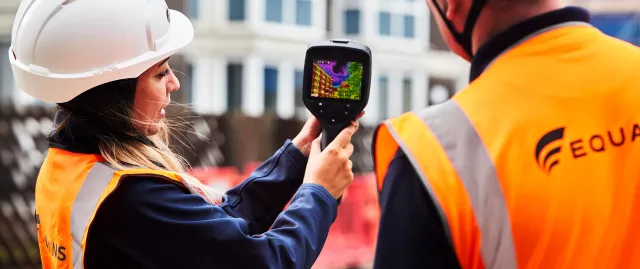
Equans gathered evidence for the assessment via two detailed, on-site inspections, of each estate to analyse and confirm site specific information. A variety of non-intrusive surveys were conducted with support from hospital staff to understand a range of clinical and nonclinical environments, including wards, theatres and plant rooms.
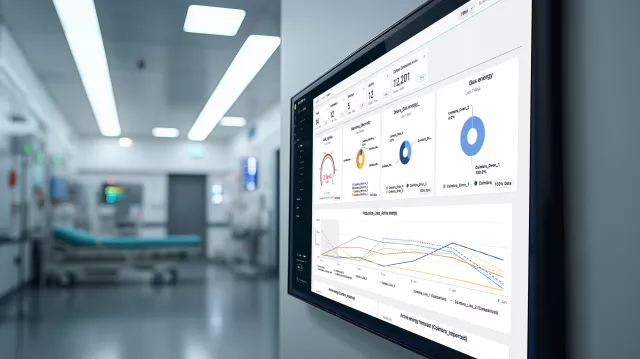
The team engaged with on-site BMS teams to review data, as well as on-site facilities management operatives to understand current and historic weather event issues that impact the estates and attributed them to both acute and chronic climate vulnerabilities.
Specialist capabilities applied
The assessment demonstrated how Equans’ use of climate risk methodologies, geospatial climate analysis and expert building engineering knowledge provided unique insights, including:
• Climate impact analysis: Evaluating impacts such as extreme rainfall and the resulting water ingress on infrastructure and service disruption.
• Targeted climate risk modelling: Pinpointing areas most likely to experience impacts from significant climate risks, from whole-sites and buildings, down to individual room and building component levels.
• Key risk identification: Equans highlighted five critical climate related risks requiring prioritisation. The report also projected how existing on-site issues such as heat stress, will likely worsen under future climate scenarios.
Excess heat disrupts hospital thermal comfort
Equans’ report, aligned with the Trust’s risk management framework, found that excessive heat can significantly impact building performance, workforce service delivery, and patient recovery.
During the UK’s September 2023 heatwave, Equans analysed 32 rooms at Leeds Teaching Hospitals, with most exceeding temperature guidelines. Given current building performance, Leeds Teaching Hospitals will experience more days of thermal discomfort as the UK climate changes - posing a growing challenge to patient care and operational resilience.
"Our analysis revealed that Leeds Teaching Hospitals sites are already facing the impacts of excessive heat and extreme rainfall, and that in all future climate scenarios, these sites are projected to experience increasing levels of physical climate risk which will have significant effects on the Trust’s buildings, their users, and consequently, the services they provide.
Taking action now with relatively modest adaptation measures can prevent costly disruptions and substantial one-off expenses in the future, ultimately saving Leeds Teaching Hospitals both time and money.”
Karl Limbert,
UK Strategy Director, Equans UK & Ireland
Impact
Equans’ assessment delivered:
• Detailed climate projections and bespoke risk thresholds: Climate risks and business continuity vulnerabilities were mapped at estate, building, and asset levels.
• Spotlight on climate risks with the greatest severity: Detailed explanation of the risk to the building, how occupiers would be affected and a suggested risk appetite classification based on impact.
• Adaptation measures to mitigate climate risks: Further opportunities to collaborate on building monitoring, implementation of nature-based solutions, and capital works for improved climate resilience.
Outcomes
Equans’ assessment is a market first which has enabled Leeds Teaching Hospitals to pre-empt the climate-related damage to buildings which could disrupt their operations - providing an opportunity to:
• Improve future resilience of the hospital to support their key objectives of providing fit-for-purpose healthcare infrastructure and providing the safest and highest quality patient care.
• Saving money compared to the cost of reactively dealing with disruption
Looking ahead
Equans continues to work in partnership with Leeds Teaching Hospitals to ensure their estate is fully prepared for climate risks. By leveraging our expertise and tailored climate risk mitigations, Leeds Teaching Hospitals is positioned to lead the way in healthcare estates-based adaptation for decades to come, from safeguarding patients and staff, to optimising the resilience of infrastructure.
Testimonials
“We are dedicated to innovation and providing the highest quality specialist and integrated care. Partnering with experts, we are proud to advance climate resilience through initiatives like the climate risk vulnerabilities, mitigations and solutions report provided by Equans.
“The report is crucial in helping us to proactively address weather-related disruption – enabling us to prioritise resources more effectively and supporting our focus on patient care. It also highlights our position as a leading NHS Trust in tackling climate challenges.”Chris Kelly,
Associate Director, Estates Compliance & Risk at Leeds Teaching Hospitals NHS Trust
Our expertise
Equans supports businesses, communities and the public sector by mobilising its expertise to provide low-carbon energy solutions, offer cutting-edge technical and FM services and transformative regeneration across the UK & Ireland.