Circular Economy
Closing the loop, empowering transitions for people, places and planetWhat is the circular economy?
The circular economy is a forward-looking model of production and consumption:
Eliminate waste and pollution
By refusing, rethinking and reducing the use of materials from the outset.
Circulate products and materials
By keeping materials in use through reuse, repair, refurbishment, and recycling.
Regenerate nature
By reducing pressure on natural systems, enabling ecosystems to recover.
At Equans, we recognise that transitioning from a traditional linear "make-use-dispose" model to a circular economy is essential to reducing environmental impact and accelerating the journey to net zero.
Our circular economy strategy is built around the model’s three core principles to minimise material consumption, maximise resource efficiency, and enable ecosystems to recover - going beyond sustainability to create meaningful social and environmental value.
Why circular economy matters
Optimising resource productivity and reducing consumption is vital to achieving the UN Sustainable Development Goals (SDGs) and delivering on our IMPACT commitments.
Our circular approach:
- Reduces embodied carbon emissions across our supply chain - a crucial step towards our net zero ambition.
- Diverts at least 100% of non-hazardous waste from landfill, cutting pollution and protecting biodiversity.
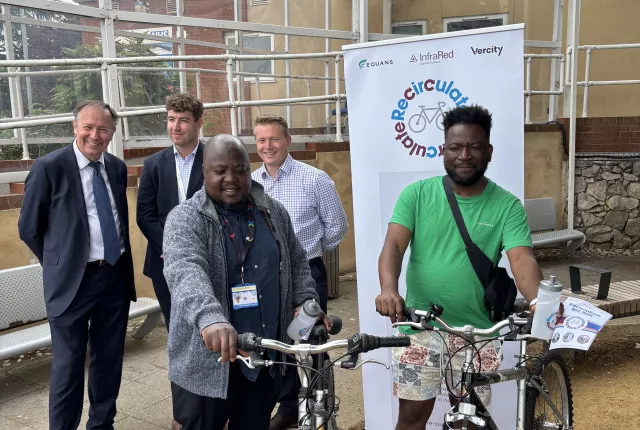
- Creates social value by partnering with local enterprises and charities, extending the life of products and upskilling communities.
How we’re making it happen
Our approach to designing out waste and pollution integrates mandatory life cycle assessments for major projects to prioritise durable, recoverable, and low-impact materials while eliminating hazardous substances and fossil fuels when possible.
This strategy is strengthened by leveraging advanced AI-powered tools which map and monitor embodied carbon and waste flows to identify reduction opportunities.

Our circular economy in action
Additionally, Equans commits to regenerating nature by using certified sustainable materials like FSC timber, investing in on-site water harvesting and sustainable fuels such as hydrotreated vegetable oil (HVO) for renewable projects, and actively promoting biodiversity restoration in the communities it serves.
Delivering value for our clients
We work closely with our clients to help advance their scope 3 and net zero targets by enhancing circularity across the supply chain and lowering carbon emissions. Moreover, we help unlock cost savings and new revenue streams via material resale and rebate schemes. Beyond environmental and economic advantages, we generate significant social value by creating employment, offering training opportunities, and supporting community initiatives.
Empowering our teams and supply chain
Through our partnership with the Supply Chain Sustainability School, we offer comprehensive training and learning resources, including our engaging circular economy fresk workshops and an internal circular economy catalogue.
We uphold clear sustainable procurement standards, actively engaging and upskilling our suppliers across all projects to ensure shared commitment to circular principles. Beyond environmental goals, we also drive meaningful social value by partnering closely with local SMEs, charities, and protected employment sectors, fostering inclusive opportunities that benefit communities and strengthen our supply chain.

Measuring progress
Our AIMS Portal tracks waste streams across our business, identifying improvement opportunities and enabling transparent reporting. Our procurement teams regularly assess supplier performance against environmental and social criteria, driving continuous improvement.
Empowering a sustainable circular future for people, places and planet
We believe a truly circular future is only possible through collective action. By working together with our clients, colleagues, and partners, we deliver a more sustainable, equitable, and resilient world for all.
Frequently asked questions
The circular economy in the built environment focuses on designing, constructing and operating buildings to minimise waste, keep materials in use, and reduce environmental impact. This includes reusing materials, extending asset lifecycles, and reducing reliance on new resources.
The circular economy reduces embodied carbon emissions by limiting the need for new materials and extending the life of existing assets. This is critical for net zero, as a significant proportion of emissions in the built environment come from materials and supply chains.
While sustainability focuses on reducing negative impact, the circular economy goes further by redesigning systems to eliminate waste, keep materials in circulation, and regenerate natural systems.
Circular approaches reduce costs by minimising waste disposal, extending asset life, and enabling material resale or reuse. They can also reduce procurement costs and improve operational efficiency.
Key challenges include supply chain complexity, lack of standardisation, data availability, and integrating circular practices into existing operations. Overcoming these requires collaboration, digital tools, and clear governance.
A circular building is designed and operated to maximise resource efficiency across its lifecycle. This includes using sustainable materials, enabling reuse and refurbishment, reducing waste, and integrating systems that extend asset life.