
Glossary Glossary 2026-06-05
What is a net zero carbon building?
A net zero carbon building is a building that produces as much carbon-free energy as it consumes over the course of a year, resulting in no net carbon emissions from its operation.
This typically involves reducing energy demand as much as possible and then meeting remaining demand through renewable or low-carbon energy sources.
Why net zero carbon buildings matter
Buildings are one of the largest sources of carbon emissions in the UK. Achieving net zero in the built environment is essential to:
- Meet national and local climate targets
- Reduce long-term energy costs
- Improve building performance and resilience
- Ensure compliance with evolving regulations
For organisations with large estates, net zero is not just a sustainability goal - it’s a strategic operational priority.
How net zero buildings are achieved?
Achieving net zero carbon requires a whole-system approach:
- Improving insulation and building fabric
- Upgrading lighting and equipment
- Optimising building controls
- Installing efficient HVAC systems
- Implementing smart building technologies
- Enhancing maintenance strategies
- Electrification of heating (e.g. heat pumps)
- Connection to heat networks
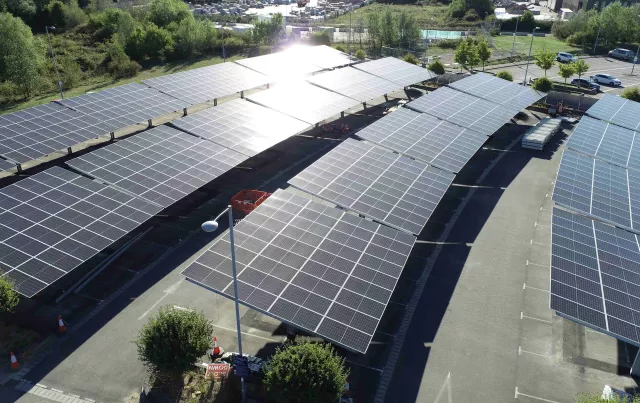
- On-site renewables (e.g.solar PV)
- Using verified carbon offset schemes as a last step
Net zero in practice
For public sector estates, housing portfolios, and commercial buildings, net zero is typically delivered through a phased decarbonisation programme, often aligned to funding schemes and compliance frameworks.

Frequently asked questions
A net zero carbon building is achieved through a whole-system approach that reduces demand, improves efficiency, switches to low-carbon energy and, where necessary, offsets residual emissions.
This may include improving insulation and building fabric, upgrading lighting and equipment, optimising building controls, installing efficient HVAC systems, using smart building technologies, electrifying heating, connecting to heat networks, or installing on-site renewables such as solar PV.
Organisations can start by reducing energy demand across their buildings. This often includes improving insulation, upgrading inefficient lighting and equipment, and optimising building controls.
Reducing demand first helps lower the amount of energy that needs to be replaced with renewable or low-carbon sources.
Organisations with large estates usually deliver net zero through a phased decarbonisation programme. This helps them plan, prioritise and fund improvements over time.
For public sector estates, housing portfolios and commercial buildings, these programmes are often aligned with funding schemes, compliance frameworks and wider operational priorities.
Decarbonisation is the process of reducing carbon emissions from a building or estate. It supports net zero by lowering emissions through energy efficiency, low-carbon heating, smart controls, renewable energy and retrofit measures.
Net zero carbon is the end goal, while decarbonisation is the process used to get there.
Retrofit refers to improving existing buildings so they perform better and produce fewer carbon emissions.
In the context of net zero, retrofit can include improving building fabric, upgrading systems, installing low-carbon technologies and optimising how a building is operated.
Yes. Existing buildings can move towards net zero carbon through targeted retrofit and decarbonisation measures.
This usually involves understanding current performance, reducing energy demand, improving system efficiency and introducing low-carbon or renewable energy solutions